

In recent years, Indian storytelling has begun to move beyond surface level entertainment and step into spaces that demand reflection and introspection. Among these emerging narratives, Chiraiya stands out as a series that does not rely on dramatic exaggeration but instead draws its strength from familiarity. Set within a traditional Indian household, it explores the delicate, often unspoken dynamics of marriage, family, and a subject that continues to remain deeply uncomfortable for many; consent within marriage.
A Familiar Home, A Familiar Woman

The series introduces viewers to Kamlesh, a homemaker whose life revolves around her family. She represents a figure that is widely recognizable across Indian homes, someone who has internalized responsibility to the extent that her own identity is inseparable from the roles she performs. Her day is structured around maintaining harmony, ensuring that the needs of others are met, and upholding the values that define what is often described as a “good family.”
There is a sense of stability in her world, one that is built on routine, mutual dependence, and an unspoken understanding of how things are meant to function. This sense of order is comforting, not only for her but for everyone around her, and it reinforces the belief that her family is, in many ways, ideal.
A Confession That Disrupts Everything

This carefully balanced life begins to shift when Pooja, her newly married sister in law, shares an experience that unsettles the very foundation of Kamlesh’s beliefs. Pooja reveals that her husband forced himself on her on their wedding night. The weight of this moment lies not only in the revelation itself but in the reaction it receives.
Kamlesh does not immediately recognize the gravity of what she has been told. Instead, she interprets it through a lens shaped by years of cultural and social conditioning. The man being accused, Arun, is someone she has known closely and cared for deeply. In her understanding, he does not fit the image of someone capable of causing harm in this way, and this belief leads her to dismiss Pooja’s claim.
Understanding the Silence Around Consent
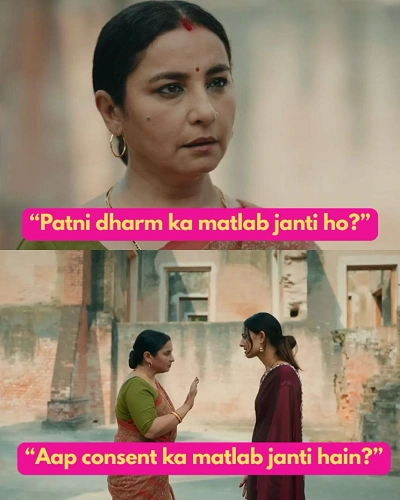
This response reflects a broader reality that exists within many households. Consent, as a concept, is often acknowledged in certain contexts, but within marriage, it is frequently assumed rather than discussed. The idea that a husband might need to seek consent, or that a wife has the right to refuse, is not always openly recognized.
As a result, experiences like Pooja’s are often minimized or misunderstood. They do not fit into the conventional narrative of what constitutes harm, and therefore they are not always treated with the seriousness they deserve. The series brings attention to this gap in understanding, showing how silence and assumptions can prevent important conversations from taking place.
The Beginning of Inner Conflict
As the story unfolds, Kamlesh’s initial certainty begins to waver. Pooja’s words linger in her thoughts, creating a sense of discomfort that she cannot easily ignore. This marks the beginning of an internal struggle, as she starts to question not only the situation but also the beliefs that have shaped her understanding of marriage and relationships.
This shift is portrayed with subtlety, allowing the audience to witness the gradual nature of change. Kamlesh is not depicted as someone who transforms instantly; instead, she navigates confusion, doubt, and emotional conflict. This approach adds depth to her character and makes her journey more relatable.
Seeking Answers Beyond the Household
In an effort to make sense of her thoughts, Kamlesh steps outside her familiar environment and seeks information from a local NGO. This decision represents a significant turning point, as it exposes her to perspectives that challenge her previous assumptions.
Through conversations with experts, she learns that consent is an essential aspect of any relationship, including marriage. It is not something that can be assumed or overlooked, and it must be ongoing and mutual. This realization forces her to reconsider what she has always believed to be normal, creating a deeper awareness of the issue at hand.
The Emotional Weight of Unlearning
The process of understanding is not without difficulty. Kamlesh’s journey is marked by a complex mix of emotions, including guilt for having dismissed Pooja’s experience and uncertainty about how to reconcile this new perspective with her existing beliefs. The series captures this emotional weight effectively, showing that change often involves confronting uncomfortable truths.
Unlearning long held ideas is rarely straightforward, particularly when those ideas are tied to one’s identity and sense of stability. By presenting this process with nuance, Chiraiya highlights the challenges that individuals may face when they begin to question deeply ingrained norms.
Reflecting a Larger Social Reality
While the narrative focuses on a single family, it also points to a broader social issue. Data from national surveys indicates that a significant proportion of married women who report sexual violence identify their husbands as the perpetrators. Despite this, the topic of marital rape remains under discussed, often due to cultural sensitivities and societal reluctance to address it openly.
By situating this issue within a domestic setting, the series brings attention to how such experiences can exist within seemingly ordinary households. It encourages viewers to consider the ways in which certain forms of harm may go unrecognized or unaddressed.
Women, Perspective, and Changing Conversations
The relationship between Kamlesh and Pooja plays a central role in the narrative, offering two different perspectives shaped by experience and generational influence. While Pooja expresses her discomfort and seeks acknowledgment, Kamlesh initially struggles to interpret the situation in the same way.
Over time, however, their interaction becomes a space for understanding and reflection. This dynamic underscores the importance of communication and highlights how conversations between women can contribute to greater awareness and empathy.
Questioning the Idea of a “Perfect Family”
Another key theme explored in Chiraiya is the concept of the “perfect family.” In many cultural contexts, maintaining harmony and preserving reputation are prioritized, sometimes at the expense of addressing underlying issues. The series challenges this notion by suggesting that true stability cannot be built on silence or denial.
Instead, it presents the idea that acknowledging difficult truths is an essential step toward creating healthier and more honest relationships. This perspective encourages a re evaluation of what it means for a family to be truly supportive.
A Subtle Yet Impactful Narrative
One of the defining features of Chiraiya is its understated approach. Rather than relying on dramatic storytelling, it presents its themes through everyday interactions and gradual developments. This allows the narrative to feel authentic and relatable, making its message more impactful.
The performances by Divya, Prasanna Bisht, and Siddharth Shaw contribute to this sense of realism, adding depth and nuance to the characters. The series, currently streaming on JioHotstar, has been drawing attention for its thoughtful exploration of a complex and sensitive subject.
Final Thought
Chiraiya is not a story that seeks to provide immediate answers or simple resolutions. Instead, it invites viewers to engage with a subject that has long remained in the background of public discourse. By presenting the issue of consent within marriage in a relatable and nuanced manner, it encourages reflection and conversation.
The series highlights the importance of awareness and the need to question assumptions that may have been accepted without examination. It suggests that meaningful change often begins with understanding, and that even small shifts in perspective can have a significant impact over time.
In bringing this conversation into the open, Chiraiya contributes to a growing dialogue about relationships, autonomy, and respect. It serves as a reminder that within any relationship, the presence of trust and mutual understanding is essential, and that these values must be actively upheld rather than assumed.
Ultimately, the strength of the series lies in its ability to resonate on a personal level while addressing a broader social issue. It leaves viewers with an opportunity to reflect, not only on the story being told but also on the beliefs and perspectives they carry with them in their own lives.
What’s Trending!

RCB Women Script History: 204 Run Chase, a Sisterhood of Fire, and a Crown That Sparkles Louder Than Ever.

Palki Sharma Steps Down as Firstpost Managing Editor: Bold Exit and the Future of Digital Journalism.

Women in Toxic: A Fairy Tale for Grown Ups: Redefining Power, Passion & Presence in Indian Cinema.

RCB Stars Shine on the Red Carpet Amid WPL Playoff Clinch 2026: Glamour, Grit and the Hunger for Silverware.

Haq on Netflix: Why Yami Gautam Dhar and Emraan Hashmi’s Powerful Film Is a Must Watch for Women Right Now.